About
Solwata is a 25-minute immersive mixed-reality experience that brings audiences into the lives of coastal communities in Solomon Islands confronting rising seas, displacement, and planned relocation. Created by NowHere Media and co-produced by Human Rights Watch and Agog: The Immersive Media Institute, the experience combines virtual reality, physical interaction, spatial audio, and documentary storytelling to explore the human rights consequences of climate change. Rather than simply learning about climate displacement and planned relocation, audiences are invited to experience it alongside the people living through it.
Runtime: 25 minutes
Format: Mixed reality
Narrator: Mark Ruffalo
Featuring: Francis Siaumari, Martha Suraau, Lawrence Too’si
Creators: Felix Gaedtke, Gayatri Parameswaran
Language: English / Solomons Pidgin / French / Spanish
Where to WatchSolwata will premiere at Venice Immersive of Venice International Film Festival, from September 2–12, 2026, in Venice, Italy. It will also be shown at the Innovation Hub of Toronto International Film Festival, from September 10-16, 2026, in Toronto, Canada; and at the BFI London Film Festival, from October 7-18 2026, in London, United Kingdom. Solwata will travel to advocacy spaces and public forums, including the annual United Nations climate conference (COP31), November 9–20, in Antalya, Türkiye, to engage policymakers, funders, journalists, and advocates in conversations about climate adaptation, planned relocation, displacement, and human rights. Check back here or follow HRW, NowHere Media, and Agog for updates on future screenings and other ways to experience Solwata.    |
Human Rights Watch’s 2025 report, There’s Just No More Land, found that the Walande community largely planned, financed, and carried out its own relocation after years of trying to adapt in place and receiving little meaningful government support. Even after relocating, the community continues to face climate-related risks. Solwata builds on that research to help audiences better understand the deeply human realities behind climate displacement and planned relocation.
Read a text description of this video
January 2025
Walande, Solomon Islands
Johnson Sua
Police Officer
I did not want to change my life. My previous life, my good life. But due to the cause of climate change, caused by the global world, factories, companies, I have to move.
Eva Cathy Iroga
Student
It’s a sad thing to see suddenly everything just wiped away, or stripped away. Everyone cried and yeah, I feel sorry for their homes that gone.
Johnson Sua
We need government to address those who directly affected. Walande is the one of the villages
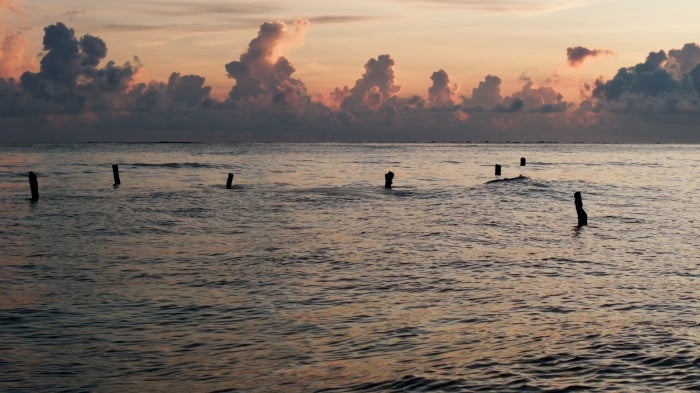
who are directly affected. We already moved from the island. You can see the empty posts standing. Wave are now coming.
Fred Dauburi
Secretary for Walande Community
As a little boy we feared nothing. We don’t worry about things. We only enjoyed fishing and then going out in the garden. But now we know that climate change really bringing disasters.
Johnson Sua
I expect government to do something for us.
Title
No More Land
Richard Kwai
We are people migrating from one place to place. So originally we came from Northeast Malaita. That's where our ancestors came from.
Text On Screen
Extreme weather events, intensified by climate change, repeatedly displaced Walande community members from their island home.
Today their island has been completely submerged by
the sea.
As a result, the people of Walande were forced to relocate to the nearby mainland.
May 1986
Solomon Islands
Richard Kwai
Chairman, Walande Church
The first destruction to the island was in 1986 when Cyclone Namu destroyed Solomon Islands. They escaped to the mainland after one week they came back and rebuild the island again to its original size. 2009 is the worst time of the climate change. Properties on the islands all destroyed. Houses were washed away, and the sea washed through the village and destroyed the houses in the middle of the village.
Susie Waita Fakaia
Nurse
I was there at that time. I was too scared. I almost break down, because I haven't seen such a big mighty waves like that, in my growing up in this village.
Richard Kwai
And that's when people decide to move.
Text On Screen
By the mid-2010s, the community had relocated to a small area on the mainland that was given to their ancestors.
87% of land in Solomon Islands is held under customary tenure, regulated by unwritten laws and oral tradition passed down from generation to generation.
Richard Kwai
And when they come to settle here, they become best friends with the landowner here. And the best friends allow them to live in this part of the southern Malaita.
Johnson Sua
We are not move here by the government. We are moved to this mainland by ourself. By our strength. The walkways and other things, it’s not built by the government. If we lean on the government, or if we lean on the other organizations of the world, we still remain the same.
Richard Kwai
During that time too, the Solomon Islands’ government supported the community by providing ten cartons of nails to build a house. Yeah...
Eva Cathy Iroga
This community here, they always work together as a family. There's a lot of many tribes here, but when it comes to do things together like (building) the footpaths, they all come together and then (get) the job done.
Text On Screen
The people of Walande showed ingenuity and leadership in their relocation, but moving an
entire community inherently involves losses.
Johnson Sua
It's really painful. Some older people they are desperately cry for the old village. Saltwater people used to live and love living in the sea. The changes of this new place really, we really lost the culture and the tradition.
Richard Kwai
We are still feeling the effect of climate change. In terms of food security, people find it difficult to catch fish now because the environment is changed. The fish habitats is already destroyed, and people move even farther to find fish. Most of our gardening on the coast is already washed away. We live on swamp taro. And now I think about 80% of the swamp taro is already destroyed and people no longer have enough of that crop. In 2021 we secured funding to put up this seawall, hoping it will mitigate coastal erosion. In 2023 we began to notice the gabion wire’s already destroyed, rusted and falling apart. We need engineers especially, because our only fear is that if we are not careful the sea erosion will continue to drag us inland.
Susie Waita Fakaia
Some of our piece of lands, especially in lowlands, the sea has already washed away, that's why we get short of land.
Fred Dauburi
At present we are just surviving on just about 50 hectares plot of land. The population of this community is increasing rapidly but a piece of land will not expand.
Richard Kwai
We will have to convince the landowners to allow us extending the boundary. With good negotiation, perhaps we can break through. It also depends on the landlord, if they're willing, they can extend the boundary for us.
Text On Screen
The future ability of the community, and its members, to remain in their new village is at risk, as is protection of their rights.
Landowners in neighboring villages say the Walande community never had permission for long-term settlement, only agricultural use.
Richard Kwai
One of our dreams is to have this land registered by the government so that we are feel secured in the future. The landowner always disturb us with this because they want to return the land from us, but then it's not our agreement with them, but it's our agreement with our ancestors.
Peter Fletcher Wate
Teacher
A lot of young people are flooding out to live somewhere especially in Honiara (capital of Solomon Islands). I also send my picaninny out, children out.
Text On Screen
The Solomon Islands’ government should uphold Walande community members’ rights, including their land rights and right to food.
It should also assess the needs of other communities facing the impacts of climate change, and provide them with adequate support if they request to relocate.
Robert Misimaka
Ministry of Lands Housing & Survey, Solomon Islands
In my view the government of Solomon Islands do seems to forget most of the people in the rural areas. We have representatives from some of these areas, but you know... They fully aware of the situations but they focus on other things apart from what’s supposed to be done when it comes to climate change, so it's kind of a wakeup call for the country because people out there really really need the support of the government, so. There are lots needs to be done.
Text On Screen
The Solomon Islands’ government launched national Planned Relocation Guidelines in 2022.
The Guidelines are a positive step but Standard Operating Procedures (SOPs) for their implementation are still under development.
Robert Misimaka
At the moment, as we speak, we are still working on our SOP: Standard Operation Procedures. We anticipated that once this is completed this year, then we might try and see how we start working on this.
December 5, 2024
Video Courtesy of the International Court of Justice
John Muria Jnr.
Solomon Islands Attorney General
While the impacts of our changing climate will continue to affect us all, those impacts are not distributed equally. As a small island, developing state and least developed country in the Pacific, Solomons is on the frontlines of the most severe and devastating impacts of climate change.
Harj Narulla
Counsel for Solomon Islands
As a least developed country, Solomon Islands will simply not have the financial and technical capacity to meet the challenges of climate change without the assistance of other states under the Paris framework.
Johnson Sua
So it's everybody's responsibility. The world, the government, ourself here in this village, myself, it's our responsibility.
Partners
Human Rights Watch produced Solwata in collaboration with partners NowHere Media and Agog: The Immersive Media Institute.
NowHere Media is an Emmy® nominated, Peabody-winning, Berlin-based studio specialising in virtual, augmented, and mixed reality experiences driven by evocative storytelling. Founded by journalists Felix Gaedtke and Gayatri Parameswaran, the studio works at the intersection of art, technology, and social change. By collaborating with film producers, nonprofits, and international organisations, NowHere Media creates impactful, co-creative pieces that address urgent global issues, including human rights, social justice, and the climate crisis to inspire and engage audiences worldwide. nowheremedia.net |

Agog: The Immersive Media Institute is a philanthropic organization that helps creators and nonprofit leaders harness extended reality (XR), including virtual reality, augmented reality, and mixed reality, to build human connection, cultivate empathy, and inspire action on urgent social and environmental challenges. Founded by Wendy Schmidt and Chip Giller, Agog plays a catalytic role at the intersection of philanthropy, technology, and culture, helping immersive media grow into a more responsible, inclusive, and impact-driven field. agog.org |

Credits
Narrated by Mark Ruffalo
In collaboration with Martha Suraau, Francis Siaumari, Lawrence Too'si and other members of Walande, Ngongosila & Kwai communities
Narrated & Executive Produced by Mark Ruffalo
Directed & Produced by Felix Gaedtke, Gayatri Parameswaran
Written by Gayatri Parameswaran
Executive Producer, Human Rights Watch Christina Curtis
Executive Producer, Human Rights Watch Sam Dubberley
Executive Producer, Agog Mary Matheson
Executive Producer, Agog Amy Seidenwurm
Assistant Producer, NowHere Media Julius Hackspiel
Assistant Producer, NowHere Media Olha Tsybulska
Line Producer Regina Lepping
Researcher & Producer, Human Rights Watch Erica Bower
Producer, Human Rights Watch Gabi Ivens
Producer, Human Rights Watch Myrto Tilianaki
Director of Photography Ignacio Ferrando
Camera Assistant Alarics Fugui
Lead Developer Felix Lange
Experience Design & Development Johannes Felix Lotze
Art Director Moritz Mayerhofer
Technical Director Henning Schild
3D Artist & Designer Margarita Gehl
360° Video Editor Christian Möller
360° Video Editor Olha Tsybulska
360° Video Post-production Adrian Meyer
Photogrammetry & Gaussian splat reconstruction Jan Burghardt
Sound Designer & Music Composer Billy Mello
Installation Concept & Design, NowHere Media Felix Gaedtke, Margarita Gehl, Johannes Felix Lotze, Olha Tsybulska
Installation Design & Build, Raumlichtlabor Thomas Foitzik, Steve Gödickmeier, Johanna Müller, Martin von Scheven, Jakob Schmidt, Alexander Schubert, Isabell Willms
Voiceover Consultant Millicent Barty, Khris Brown, Recording Studio, Honiara Splat Recordz, Recording Studio, Rome Kea Studios, Voice Over Actors (English) : Narrator Mark Ruffalo, as Francis Siaumari Rodney Paul Rimou Nikae, as Martha Suraau Joanna Sireheti, as Lawrence Too'si Junior Campbell
Voice Over Actors (Pidgin) : Narrator Regina Lepping, as Francis Siaumari Francis Siaumari, as Martha Suraau Joanna Sireheti, as Lawrence Too'si Lawrence Too'si
Voice Over Actors (French): Narrator Elvire Fondacci, as Francis Siaumari Vincent Pearce, as Martha Suraau Perrine Vaillant, as Lawrence Too'si Joachim Leroy-Vaillant, Voice Over Actors (Spanish) : Narrator Katherine La Puente, as Francis Siaumari Norman Nissim, as Martha Suraau Laura Prieto Uribe, as Lawrence Too'si Tomás Piquero Uribe
Communications Manager, NowHere Media Daisy Huntington
Interns, NowHere Media
Production Assistant Eliane Eid, Elisa Waegemans, Junior Technical Artist Nicola Bisset, Jonas Mantay, Avani Vidhani
Translators : Pidgin Jojo Lepping, Regina Lepping, Lau Alarics Fugui, French Anna Savage, Spanish Nicolas Suarez
Special Thanks to Amy Rao, Wendy Schmidt
Thanks to Jasmin Askew, Azad Balabanian, Federico Borello HRW, Maria Laura Canineu HRW, Alex Capriotti, Raul Carvajal, Erika Croxton, ETL Otto, Derr & Kollegen GmbH, Lama Fakih HRW, PYARé Friquet, Chip Giller, Lilian Hess, die reiseagentin Jana Buhl, Studio Kiefholzstraße, Wiesje Kuijpers, Jen MacDonald, Matt Myers HRW, Yuki Nishimura HRW, Richard Pearshouse HRW, Laura Prieto Uribe HRW, Aisling Reidy HRW, Matthew Reysio-Cruz HRW, Daniel Sproll, Ekin Ürgen HRW, Sofie Vandeputte HRW
Aerial and Satellite imagery
Aerial Imagery National Archives and Records Administration
Satellite Imagery © 2026 Vantor, Airbus, EUSI, Google Earth
Satellite Imagery NASA-Credit: Image data: ‘Blue Marble: Next Generation’ courtesy of NASA Earth Observatory
AI assistance
Script refining & editing AIA Primarily human, Stylistic edits, Human-initiated, Reviewed, Chat GPT, Gemini, Claude 2025-2026
Coding AIA Human-AI blend, Stylistic edits, Content edits, New content, Human-initiated, Reviewed, Claude Code 2025-2026